Inside our farm of hundreds of Bambu printers
What it actually means to run a fleet this size: parallel dispatch, day-and-night cycles, redundancy as a feature, and why fleet scale is what compresses your lead time.
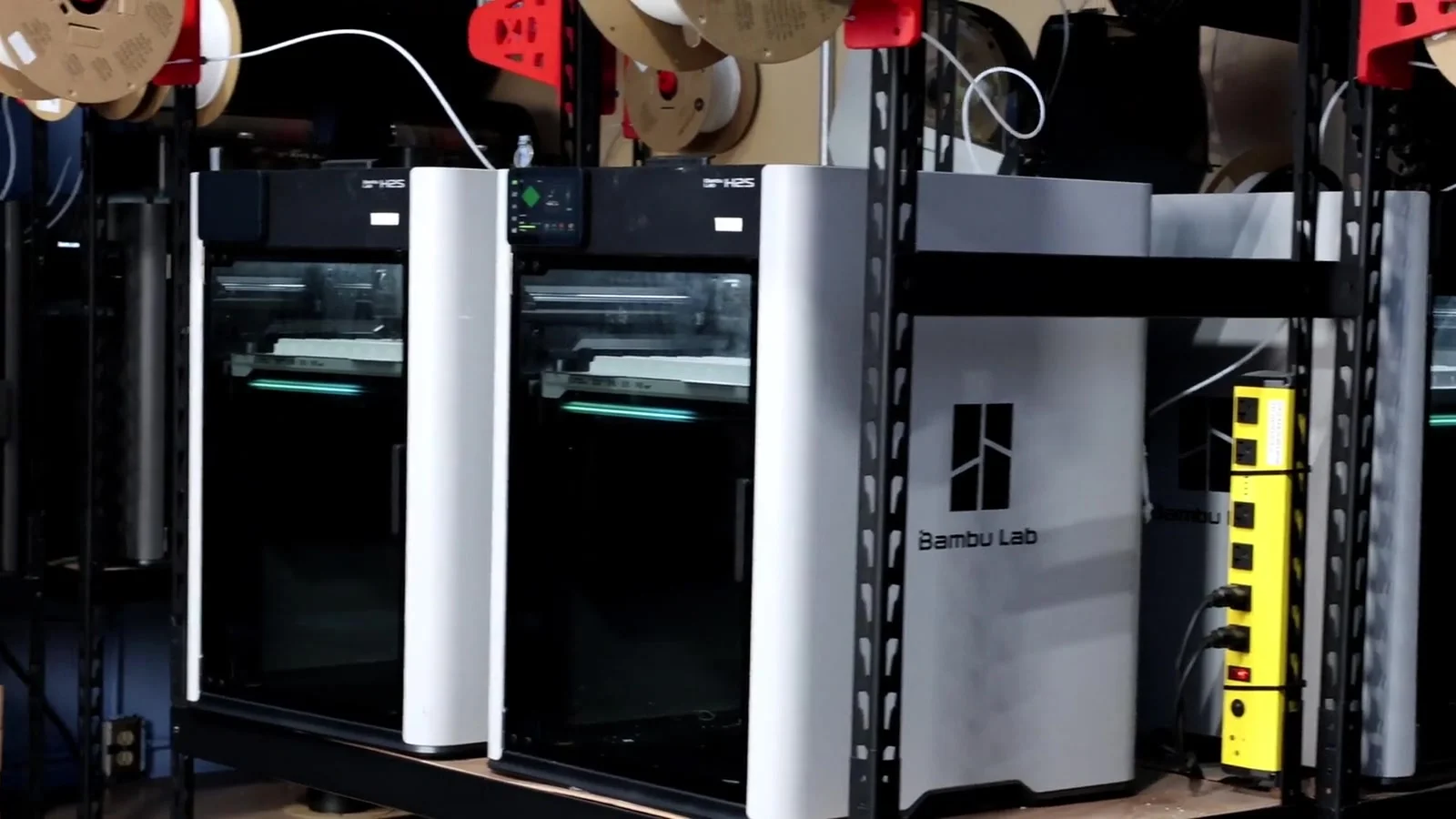
Hundreds of machines, in plain terms
The headline number gets attention. The number that matters day-to-day is what the fleet collectively produces in a week.
Our floor is dominated by industrial-grade Bambu Lab machines — chosen for speed, multi-color capability, and a wide engineering material range. The library runs from everyday PLA through engineering nylons, carbon-fiber composites, ESD-safe PETG, and flexibles. Every printer can handle the breadth.
The practical effect: at any given moment, dozens of machines are simultaneously producing parts across the full material range, in different colors, for different customers.
Parallel dispatch — the real win
A typical print farm has a queue. Your order arrives, sits behind everyone else's, and prints serially. Three different jobs from three different customers? They print in sequence.
That's not how we run.
When a job needs 50 identical parts, our scheduling system dispatches it across every machine that is already clear, and keeps adding more as they free up — a job placed today is commonly running on 40 or more printers within days. A multi-part assembly with different materials per component gets routed to the printers best-suited for each part. A rush order doesn't fight for queue position — it goes to whichever machines are clearest right now.
The result: production runs that would take days at a smaller print farm finish in hours.
Day and night — the floor doesn't stop
We run seven days a week with day and night shifts. Printers aren't cold half the time; they're printing, in post-processing, being re-spooled for the next job, or rotating through maintenance.
If you submit a file at 4pm, the queue picks it up on the same shift. Submit at 4am, you're in the start-of-day batch. Lead times don't get pinned to office hours.
Redundancy as a feature
A small print farm has single points of failure. If the one machine that prints PA6-CF goes down, that material is offline. If a 12-hour print fails 10 hours in, the customer waits another 12 to retry.
At our scale, no single machine is a bottleneck. Multiple printers run every material. Failed prints re-dispatch immediately to a clear machine. Maintenance happens in rotation — there's always available capacity somewhere on the floor.
For customers, this means a missed deadline becomes very hard to manufacture. Your part isn't waiting on one specific machine being available.
What this means for your lead time
Fleet size is the lever that compresses lead times. Orders that would queue for a week at a smaller shop ship in days here. Production runs that customers might otherwise push to MJF — a tradeoff we covered separately — often fit comfortably in our parallel FDM dispatch at a fraction of the cost.
For most production work, this is the difference between "we can do it eventually" and "we can do it now."
How to start
If your part is waiting on someone else's queue, submit your file. We'll quote it across every applicable material, give you an honest lead time, and route it to the right machines on the floor. Recommendations and lead-time estimates are free.